
The Ferrari 458 occupies a distinct position in the used Ferrari market. A newer Ferrari can be faster, more capable and easier to drive quickly. It cannot recreate the moment when a naturally aspirated, mid-engined V8 was the centre of Ferrari’s regular production range. That distinction helps explain its position alongside newer Ferrari models.
Compare Swiss asking prices by mileage (October 2026) · Explore the data behind the charts
The evidence reviewed here supports sustained interest in well-preserved, original 458s. Its naturally aspirated engine, design and usability distinguish it from its successors; those characteristics underpin the case for future appreciation, although they do not establish a guaranteed return. But “the 458” is not one uniform asset. An Italia with a strong history, a tired Spider and a low-mileage Speciale occupy very different markets. The purchase price still matters enormously.
This expanded review brings together 45 Swiss asking prices, 17 US auction results and the specification details that can change a buyer’s decision. We distinguish recorded asking prices and auction results from estimated specification premiums and future scenarios. Luxury Obsession offers Ferrari driving experiences, including the 458; this analysis is not an independent vehicle appraisal. The research is based on October 2026 data.
Ferrari 458 prices in Switzerland: a more useful buying reference
For a lower-mileage Ferrari 458 Italia, around CHF 190,000 is a more useful starting reference than the CHF 169,900 median of our entire sample. The comparable 458 Spider reference is around CHF 220,000. These figures describe the medians of advertised cars with no more than 50,000 km; they are not guaranteed sale prices or an independent assessment of condition. Rosso Corsa, a coherent interior, factory carbon and racing seats can justify looking towards the upper end, provided the history and condition support the asking price.
Applying the same 50,000 km ceiling to all four models leaves 22 of the original 45 observations. The Italia median rises to CHF 189,500 (3 cars) and the Spider to CHF 219,900 (2 cars), compared with CHF 205,750 for the 488 GTB (10 cars) and CHF 229,000 for the 488 Spider (7 cars). The coupé gap narrows from about 18% to 9%; the Spider gap from about 12% to 4%. These are asking-price comparisons, not proof that mileage alone explains the difference. With only three Italias and two Spiders, one unusual car can materially change the result.
| Model | Cars ≤50,000 km | Median asking price CHF | Lowest CHF | Highest CHF |
|---|---|---|---|---|
| 458 Italia | 3 | 189’500 | 179’999 | 270’000 |
| 458 Spider | 2 | 219’900 | 214’900 | 224’900 |
| 488 GTB | 10 | 205’750 | 189’890 | 249’900 |
| 488 Spider | 7 | 229’000 | 219’488 | 233’300 |
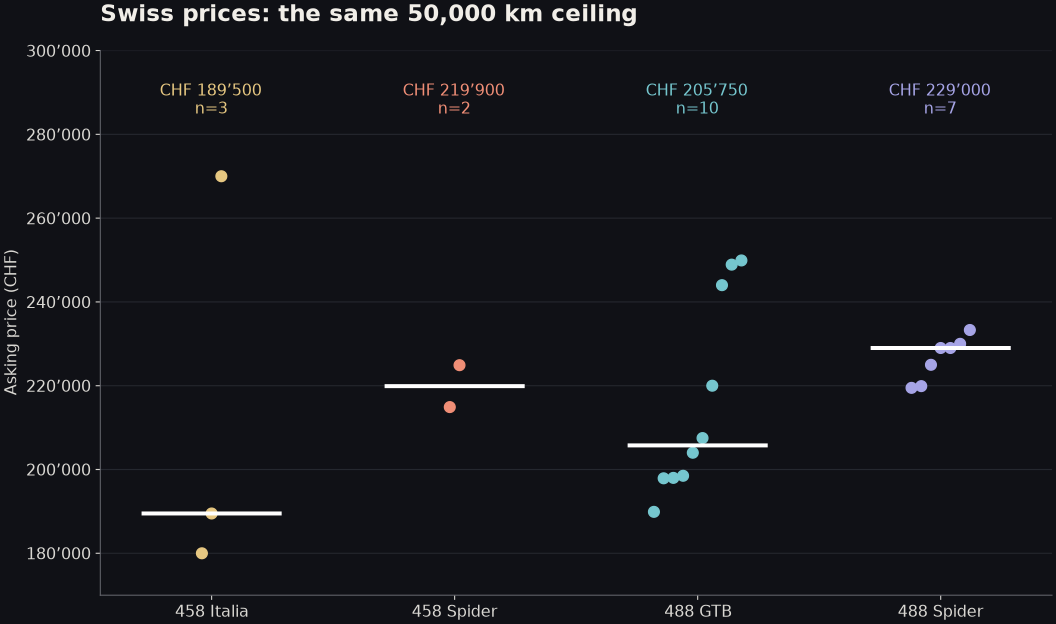
This is the stronger case for the 458: desirable examples can approach, overlap or individually exceed 488 asking prices despite being older. Our matched-mileage subset still does not show the regular 458 consistently costing more than the 488. For lower-mileage examples, we use the reference above and distinguish exceptional asking prices from the rest of the sample. A low odometer reading is a screening criterion, not a certificate of quality.
A separate Carindex advertisement for a 458 Italia at CHF 219,900 provides another example of a higher asking price. Its publicly accessible record does not give us enough mileage and condition detail for a matched comparison, so it is not added to the 45-car dataset or its medians.
Swiss Ferrari 458 and 488 prices: the full-market sample
The Swiss sample contains 15 Ferrari 458 Italias, six 458 Spiders, 12 Ferrari 488 GTBs and 12 488 Spiders. These are public advertisements, not completed transactions. The selection covers standard road cars displayed on the first results pages of AutoUncle’s Swiss 458 listings and its 488 listings. It includes high-mileage examples rather than quietly removing the cheaper end of the market.
The first striking point is the breadth of the prices. The Italia sample runs from CHF 157,900 to CHF 270,000; the GTB sample from CHF 168,500 to CHF 249,900. A headline such as “458 prices have reached CHF 270,000” would therefore miss most of the market. That upper 458 asking price belongs to a 10,600 km car. It tells us something about the seller’s expectations for a scarce specification or condition category, but it does not establish a transaction value for an ordinary example.
| Model | Sample | Lowest CHF | Median CHF | Highest CHF | Median km |
|---|---|---|---|---|---|
| 458 Italia | 15 | 157’900 | 169’900 | 270’000 | 62’300 |
| 458 Spider | 6 | 169’900 | 196’950 | 224’900 | 68’422 |
| 488 GTB | 12 | 168’500 | 201’250 | 249’900 | 26’250 |
| 488 Spider | 12 | 159’500 | 219’694 | 233’300 | 47’300 |
The Italia median is CHF 169,900 against CHF 201,250 for the GTB. However, the median mileages are 62,300 km and 26,250 km respectively. Those are not equivalent cars. The Spider medians, approximately CHF 196,950 and CHF 219,694, carry the same warning: the 458 sample is older and has a higher median mileage. Read these figures as a map of available stock, not a controlled experiment proving one model’s superiority.
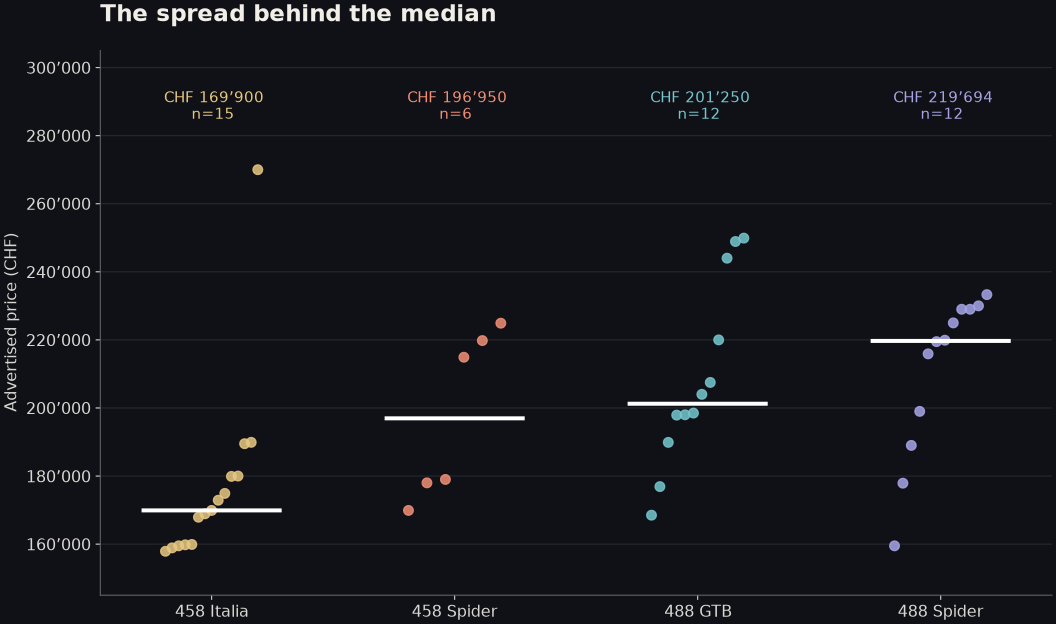
The sample shows that a 458 can still sit within striking distance of its newer successor despite its age and accumulated use. That is a more defensible statement about enduring desirability than claiming the 458 is always more expensive. The 488 still commands substantial money, particularly as a Spider or a low-mileage GTB, and our sample does not demonstrate that it is currently falling across the board.
Mileage matters, but it is not a valuation formula
Plotting all 45 advertisements makes the overlap visible. There are 458 Italias around CHF 158,000–190,000 across a broad mileage range, and 488 GTBs advertised above CHF 240,000 with relatively little use. There is also a 488 Spider at CHF 159,500 with 158,500 km. Removing that car would make the sample look tidier, but less honest about the range buyers can encounter.
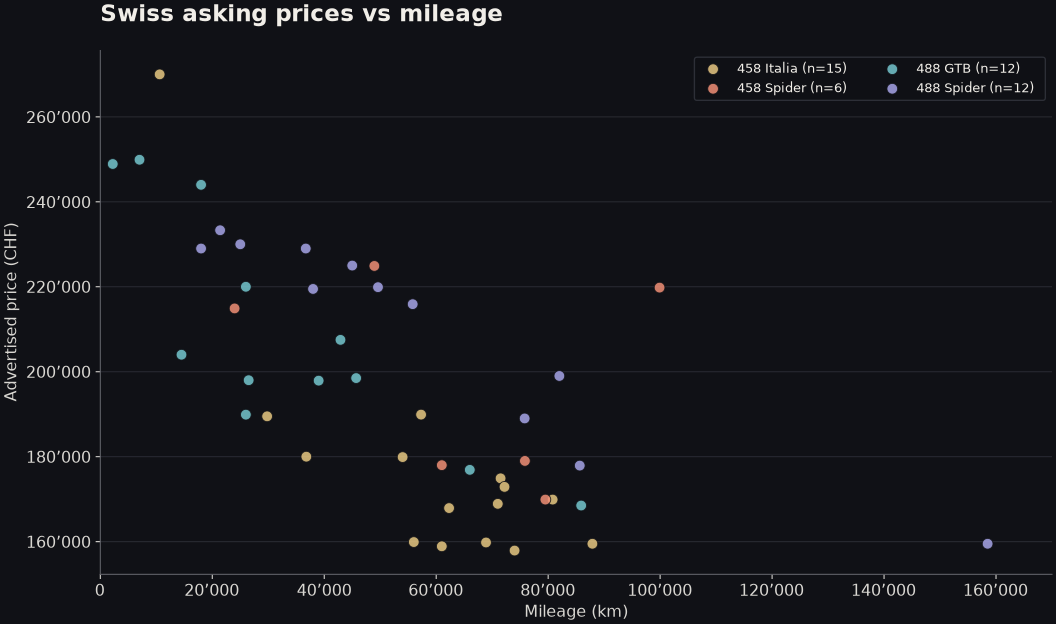
The data do not support a fixed “CHF per kilometre” deduction. Two cars with 50,000 km can have very different histories. Consistent servicing, the condition of the brakes and tyres, accident repairs, paintwork, the gearbox, suspension and the quality of previous ownership can outweigh a modest mileage difference. A pre-purchase inspection and invoices are more useful than assuming a low odometer automatically means a better car.
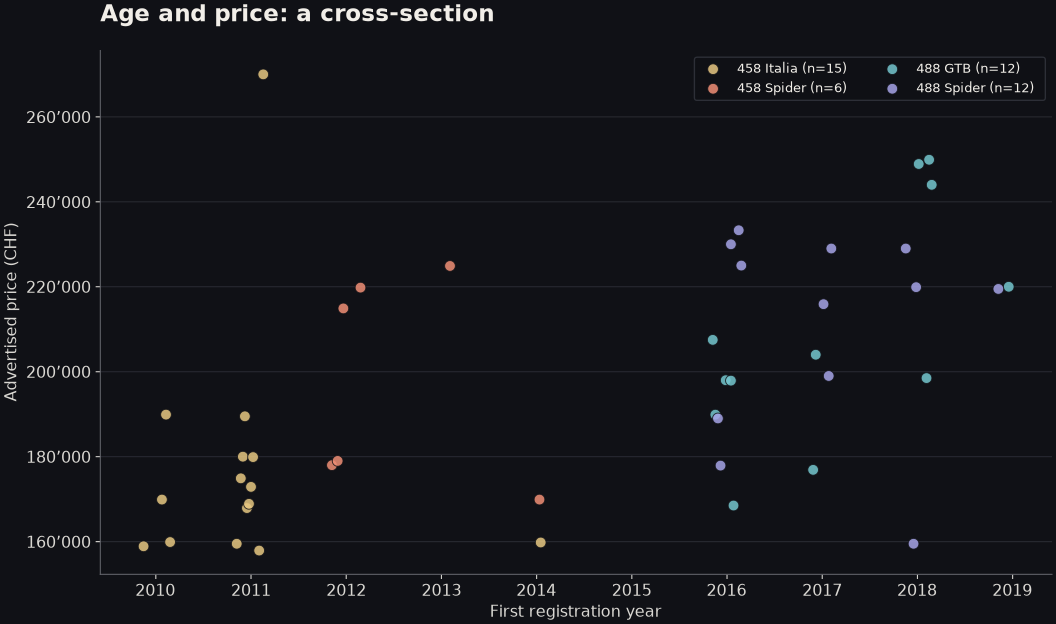
The registration-year chart adds another perspective. It compares different cars advertised at the same research date; it is not a historical price curve. Older 458s still overlap newer 488s, while large differences exist within the same registration year. This is why we have replaced a smooth-looking market narrative with individual observations. We do not have a sufficiently reliable Swiss monthly transaction series to draw one honestly.
A regular-use car with a coherent history may be a more satisfying purchase than an exceptional low-mileage example bought at a collector’s premium. If you intend to drive it, the premium paid for near-delivery mileage can disappear as soon as your ownership changes that defining characteristic. Buying the right category for your intended use matters as much as choosing the right model.
Ferrari 458 value outlook: the factors supporting long-term demand
The 458 Italia and Spider represent the final naturally aspirated V8 generation in Ferrari’s regular mid-engined two-seat range. The Speciale belongs to that same generation, but its limited availability and more focused character put it in a separate collecting category. The standard Italia does not need to become a Speciale to have a compelling future: its own engine response, sound and proportions are already sufficient reasons to want one.
That distinction becomes more important as the market moves towards turbocharged and hybrid performance. A 458 is no longer the latest solution to going quickly. It is a particular experience that newer technology cannot replace exactly. These are lasting differences in the product itself. Their effect on future prices will depend on demand, condition and the number of comparable cars available.
There are limits to the argument. Ferrari built enough regular 458s that condition and specification will continue to separate the best cars from the rest. Recession, financing costs, changing tastes or expensive repairs can interrupt appreciation. A five-to-ten-year ownership scenario allows for market cycles; it does not guarantee a profitable resale. Any rise in the car’s gross price must also cover servicing, storage, insurance, financing and selling costs before it becomes an actual investment return.
The US comparison: stronger prices, useful signals, different market
The American market is useful because public auctions reveal actual winning bids. Our chart includes 12 458 Italia results from 2025–2026 and five 488 GTB results from 2026 on Bring a Trailer. All 17 individual auction links are available in the data section. The plotted amounts exclude buyer fees and are in US dollars; they are not Swiss prices converted at an assumed exchange rate.
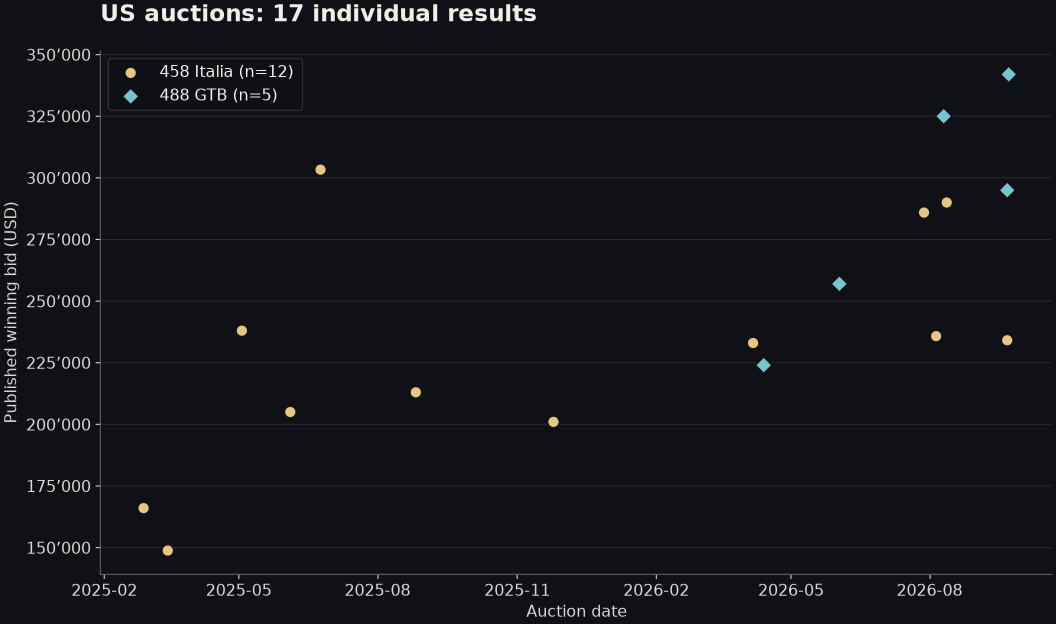
Within this selection, the 458 bids range from USD 148,789 to USD 303,330. The spread alone should discourage any universal valuation. A 2015 car with 831 miles reached USD 303,330 in June 2025, while a 2011 example with approximately 23,000 miles achieved USD 290,000 in August 2026. The latter was Grigio Silverstone with a Nero interior—a useful reminder that a desirable Ferrari does not have to be red.
Several 2026 results support the view that buyers are willing to pay serious money for the Italia. But these are different cars, not repeat sales of the same vehicles. Their mileage, condition, modifications, equipment and auction presentation differ. The 488 results are also strong, ranging from USD 224,000 to USD 342,000 in this small selection. They do not support a simplistic “458 rising, 488 collapsing” story.
The US results demonstrate international demand for the 458, but do not establish an equivalent Swiss price level or future growth rate. The buyer pool, taxation, import costs, specification and local supply differ. An American winning bid is evidence of international demand, not an immediately achievable Swiss resale price. An imported car also needs a complete landed-cost and compliance calculation; a dollar figure alone is not an arbitrage opportunity.
What recent publications are saying
There is support for the collecting thesis beyond owners’ enthusiasm. Hagerty’s 11 June 2026 analysis reported a 57% annual increase for an excellent-condition 458 Speciale, to USD 845,000. That is an important signal for the family’s most collectible derivative, not a 57% appreciation claim for the ordinary Italia. Hagerty had already examined the broader 458’s collectible appeal in an October 2023 article.
The Molly Report’s 7 July 2026 valuation discussion also treats the 458 family as a market increasingly shaped by collectibility, while separating the regular cars from the Speciale. These publications discuss scarcity and character as factors in collector demand. They are not a promise that every Swiss Italia will appreciate at the same rate, and the movement of a top derivative should never be pasted onto the entire range.
Rosso Corsa, black leather and the specification premium
For a conventional mid-engined Ferrari, Rosso Corsa remains a particularly easy specification to understand and market. We use an indicative 3–7% premium over a less sought-after colour on an otherwise equivalent car. This is an editorial estimate for buyer preference, not a measured Swiss regression. On a CHF 180,000 reference car, that is approximately CHF 5,400–12,600. Rare factory colours, unusually elegant combinations or a determined collector can reverse the comparison completely.
Black leather is similarly a broadly acceptable pairing, especially with red paint. Our indicative estimate is 0–2%, or CHF 0–3,600 on the same reference value. This reflects potential resale appeal, not a guaranteed increase in sale price. Beige, Cuoio or another carefully coordinated interior is not automatically inferior. Originality, condition and coherence matter more than applying a colour rule mechanically.
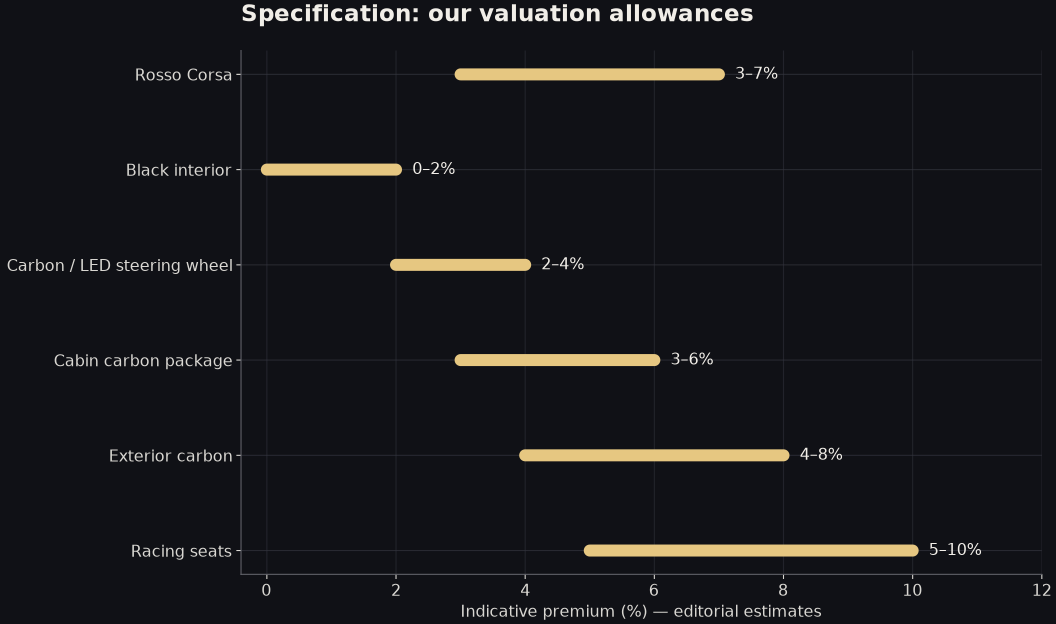
The carbon-fibre steering wheel with shift LEDs combines a visible cabin upgrade with a functional shift indicator. It is visible every time the car is driven and makes the cabin feel more special. We estimate an indicative 2–4% allowance for an original factory-equipped car compared with an otherwise comparable example without it. A broader cabin carbon package might justify 3–6%, but that package can already include the steering-wheel benefit: these percentages must not be added together indiscriminately.
Factory exterior carbon and racing seats are especially expensive and desirable options. We use estimated comparison allowances of 4–8% for a meaningful exterior carbon specification and 5–10% for desirable factory racing seats, depending on completeness, condition and buyer fit. A single carbon detail is not a full package. Damaged carbon, undocumented retrofits or seats that do not suit the buyer can erase the supposed premium.
| Specification | Estimated premium | Illustration at CHF 180,000 |
|---|---|---|
| Rosso Corsa | 3–7% | CHF 5’400–12’600 |
| Black interior | 0–2% | CHF 0–3’600 |
| Carbon / LED steering wheel | 2–4% | CHF 3’600–7’200 |
| Cabin carbon package | 3–6% | CHF 5’400–10’800 |
| Exterior carbon | 4–8% | CHF 7’200–14’400 |
| Racing seats | 5–10% | CHF 9’000–18’000 |
Why the original option invoice matters
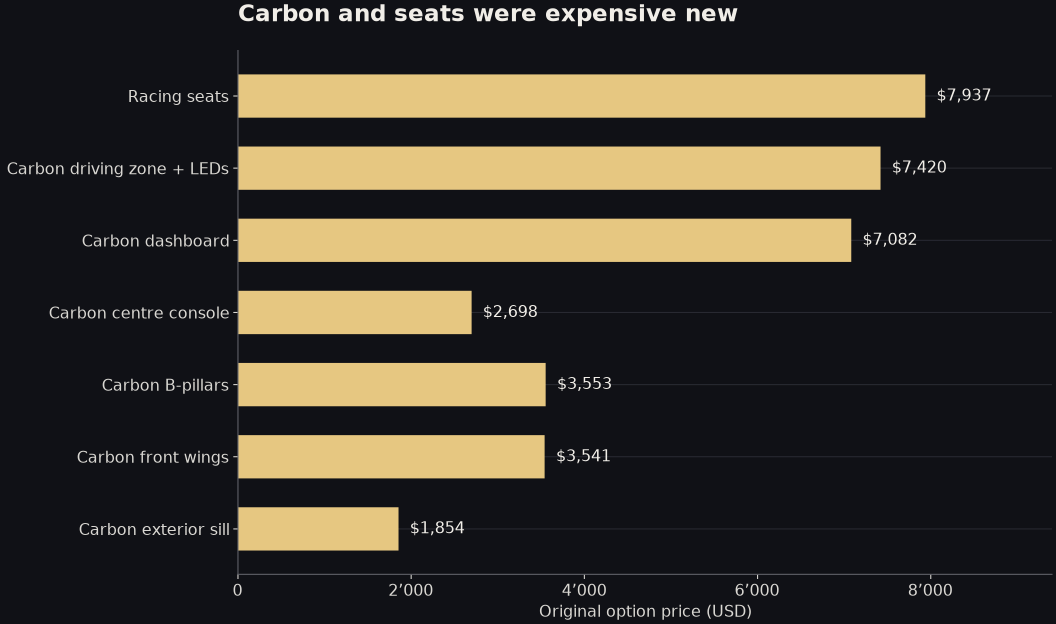
One documented US-market 2014 458 Spider specification advertised by Park Place lists racing seats at USD 7,937, the carbon driving zone with LEDs at USD 7,420 and a carbon dashboard at USD 7,082. These are original option prices for one example, not present-day Swiss premiums. They show why an extensively optioned cabin and exterior can represent a meaningful difference between two superficially similar cars.
| Specification | USD |
|---|---|
| Racing seats | 7’937 |
| Carbon driving zone + LEDs | 7’420 |
| Carbon dashboard | 7’082 |
| Carbon centre console | 2’698 |
| Carbon B-pillars | 3’553 |
| Carbon front wings | 3’541 |
| Carbon exterior sill | 1’854 |
However, expensive when new does not mean fully recoverable today. Factory specifications and supporting paperwork help distinguish original equipment from aftermarket carbon. Racing seats and LEDs do not compensate for poor maintenance. The most convincing collector specification is a complete package: desirable equipment, coherent colours, originality and strong documentation, with no serious compromises underneath.
What depreciation elsewhere in the Ferrari range tells us
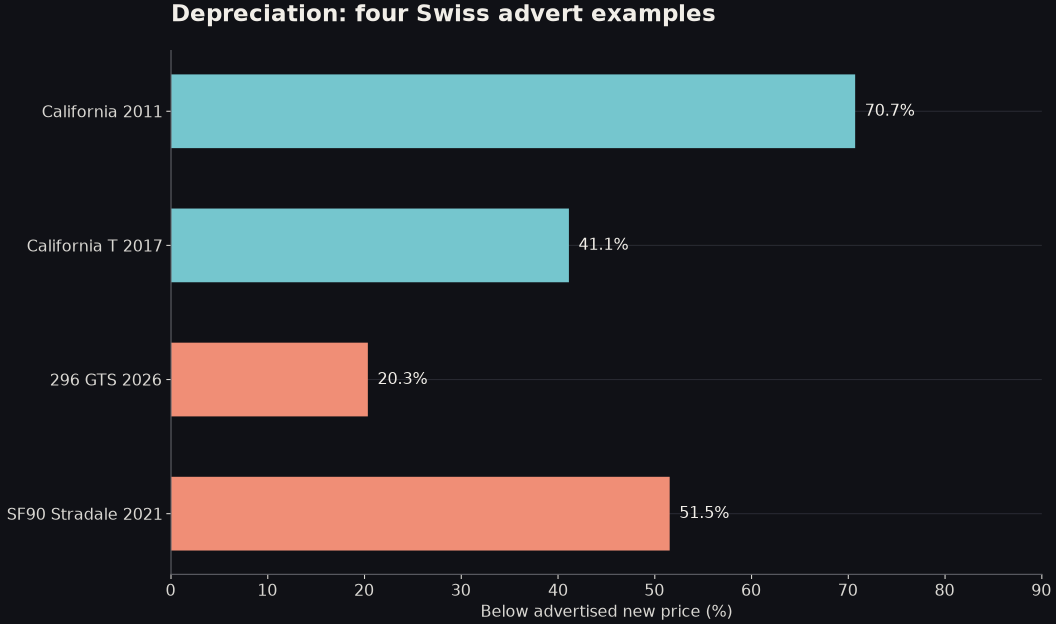
The 458’s case is easier to understand alongside Ferraris that have already moved substantially below their advertised new prices. Four Swiss advertisements illustrate the contrast: a 2011 California at CHF 79,000 against a stated CHF 269,700 new price; a 2017 California T at CHF 129,900 against CHF 220,634; a 2026 296 GTS at CHF 309,889 against CHF 389,035; and a 2021 SF90 Stradale at CHF 315,000 against CHF 650,000.
| Example | Advertised new price CHF | Asking price CHF | Difference | Source |
|---|---|---|---|---|
| California 2011 | 269’700 | 79’000 | 70.7% | Autolina: historical listing no longer available (October 2026 data). |
| California T 2017 | 220’634 | 129’900 | 41.1% | Source |
| 296 GTS 2026 | 389’035 | 309’889 | 20.3% | Source |
| SF90 Stradale 2021 | 650’000 | 315’000 | 51.5% | Source |
Those differences are approximately 70.7%, 41.1%, 20.3% and 51.5%. They are four seller-advertised comparisons, not audited purchase invoices or model-wide depreciation rates. The cars have different ages, mileages, options and histories. In particular, an older California has had far longer to depreciate than a 2026 296. The comparison illustrates the size of potential new-to-used discounts, not an equal-period performance ranking.
A technical correction matters: the original California has a naturally aspirated V8; the California T is turbocharged. Both are front-engined GT convertibles with a different buyer proposition from the 458. The 296 is a V6 hybrid and the SF90 Stradale a more expensive V8 hybrid flagship. The latter should not be confused with the rarer SF90 XX. Their performance is remarkable, but technological sophistication and a high original price do not automatically create residual-value protection.
The comparison highlights the distinction between performance specifications and retained value. The 458’s naturally aspirated layout gives it a different proposition from newer hybrid models. It does not mean a depreciated 296 or SF90 is a bad car; for someone prioritising performance, a lower used price can make it more attractive. These are different reasons to buy a Ferrari, and different risks to take with the purchase price.
Buying a Ferrari 458: the checks that matter
A sound comparison starts with an independent inspection, documented maintenance and a price consistent with the car’s actual category. Original factory equipment, a coherent colour combination, the carbon LED wheel and suitable racing seats are further differentiators. Any premium should be assessed against comparable vehicles; the most optimistic advertisement is not proof of a transaction value.
The documented asking prices, US auction results and collector-market coverage establish the 458’s continuing relevance. They support a case for selective appreciation of well-preserved examples, but do not measure a future Swiss growth rate. The evidence is strongest for enduring demand and differentiation between individual cars, rather than a uniform increase across the range.
Questions buyers ask
How much does a Ferrari 458 cost in Switzerland in 2026?
In our sample, cars with up to 50,000 km have median asking prices of CHF 189,500 for the 458 Italia (3 cars) and CHF 219,900 for the Spider (2 cars). The full sample has lower medians because it also includes higher-mileage cars. Equipment, history and condition can materially change an individual price.
Are these actual sale prices?
Swiss figures are asking prices. US figures are published auction winning bids before buyer fees. Neither sample is a complete market index.
Is a 458 guaranteed to appreciate?
No. Our outlook is positive for carefully selected original cars over a long holding period, but condition, purchase price, market changes and ownership costs matter.
Can specification premiums be added together?
No. These are editorial estimates for otherwise comparable cars. Cabin carbon and the LED wheel overlap, and the total depends on the whole specification.
Why are US prices not a Swiss valuation?
Currency, taxes, import costs, specification, supply and buyer demand differ. US results are evidence of international interest, not a local resale guarantee.
Sources, sample and downloadable data
The Swiss observations were collected from publicly displayed aggregator listings available in October 2026. Search-page coverage is a convenience sample, not the entire Swiss market. A named Novitec conversion, a Challenge car and a 488 with ambiguous 2026 registration were excluded. Aggregators may retain stale advertisements or duplicates; we checked the recorded model/year/mileage combinations, but could not verify chassis numbers, availability or eventual sale prices. Prices have not been adjusted for condition, VAT status, provenance or equipment.
The US selection consists of identifiable published winning bids, not a complete auction index. Mileage is recorded where obtained; a blank means not captured, not zero. There is no currency conversion, fitted appreciation rate or projection disguised as an observation. The option-premium ranges are our own estimates and overlap. Every graph has an accompanying data table below; the original-option and depreciation sources are linked in their respective sections.
View the underlying data — 45 CH + 17 US
| Model | Year | Mileage (km) | Asking price (CHF) | Source |
|---|---|---|---|---|
| 458 Italia | 2011 | 87’900 | 159’500 | AutoUncle |
| 458 Italia | 2010 | 61’000 | 158’900 | AutoUncle |
| 458 Italia | 2011 | 71’500 | 174’900 | AutoUncle |
| 458 Italia | 2011 | 36’800 | 179’999 | AutoUncle |
| 458 Italia | 2011 | 29’800 | 189’500 | AutoUncle |
| 458 Italia | 2011 | 62’300 | 167’900 | AutoUncle |
| 458 Italia | 2011 | 71’000 | 168’900 | AutoUncle |
| 458 Italia | 2011 | 72’200 | 172’890 | AutoUncle |
| 458 Italia | 2011 | 54’000 | 179’900 | AutoUncle |
| 458 Italia | 2014 | 68’900 | 159’800 | AutoUncle |
| 458 Italia | 2010 | 80’800 | 169’900 | AutoUncle |
| 458 Italia | 2011 | 74’000 | 157’900 | AutoUncle |
| 458 Italia | 2010 | 57’300 | 189’900 | AutoUncle |
| 458 Italia | 2011 | 10’600 | 270’000 | AutoUncle |
| 458 Italia | 2010 | 56’000 | 159’900 | AutoUncle |
| 458 Spider | 2012 | 61’000 | 178’000 | AutoUncle |
| 458 Spider | 2012 | 75’844 | 179’000 | AutoUncle |
| 458 Spider | 2012 | 23’987 | 214’900 | AutoUncle |
| 458 Spider | 2014 | 79’500 | 169’900 | AutoUncle |
| 458 Spider | 2013 | 48’950 | 224’900 | AutoUncle |
| 458 Spider | 2012 | 99’900 | 219’800 | AutoUncle |
| 488 GTB | 2016 | 42’900 | 207’500 | AutoUncle |
| 488 GTB | 2016 | 26’000 | 189’890 | AutoUncle |
| 488 GTB | 2017 | 66’000 | 176’900 | AutoUncle |
| 488 GTB | 2017 | 14’500 | 204’000 | AutoUncle |
| 488 GTB | 2019 | 26’000 | 219’999 | AutoUncle |
| 488 GTB | 2016 | 26’500 | 198’000 | AutoUncle |
| 488 GTB | 2018 | 2’222 | 248’900 | AutoUncle |
| 488 GTB | 2016 | 39’000 | 197’900 | AutoUncle |
| 488 GTB | 2016 | 85’900 | 168’500 | AutoUncle |
| 488 GTB | 2018 | 45’700 | 198’500 | AutoUncle |
| 488 GTB | 2018 | 7’000 | 249’900 | AutoUncle |
| 488 GTB | 2018 | 18’000 | 243’999 | AutoUncle |
| 488 Spider | 2019 | 38’000 | 219’488 | AutoUncle |
| 488 Spider | 2018 | 18’000 | 229’000 | AutoUncle |
| 488 Spider | 2016 | 75’800 | 189’000 | AutoUncle |
| 488 Spider | 2016 | 85’643 | 177’900 | AutoUncle |
| 488 Spider | 2018 | 158’500 | 159’500 | AutoUncle |
| 488 Spider | 2018 | 49’600 | 219’900 | AutoUncle |
| 488 Spider | 2017 | 55’800 | 215’900 | AutoUncle |
| 488 Spider | 2016 | 25’000 | 229’999 | AutoUncle |
| 488 Spider | 2017 | 82’000 | 199’000 | AutoUncle |
| 488 Spider | 2017 | 36’700 | 229’000 | AutoUncle |
| 488 Spider | 2016 | 21’400 | 233’300 | AutoUncle |
| 488 Spider | 2016 | 45’000 | 224’990 | AutoUncle |
| Model | Auction date | Model year | Miles | Winning bid (USD) | Source |
|---|---|---|---|---|---|
| 458 Italia | 2025-02-27 | 2011 | 53’000 | 166’000 | Bring a Trailer |
| 458 Italia | 2025-03-15 | 2010 | 17’000 | 148’789 | Bring a Trailer |
| 458 Italia | 2025-05-03 | 2013 | 4’800 | 238’000 | Bring a Trailer |
| 458 Italia | 2025-06-04 | 2011 | 11’000 | 205’000 | Bring a Trailer |
| 458 Italia | 2025-06-24 | 2015 | 831 | 303’330 | Bring a Trailer |
| 458 Italia | 2025-08-26 | 2011 | 17’000 | 213’000 | Bring a Trailer |
| 458 Italia | 2025-11-25 | 2013 | 25’000 | 201’000 | Bring a Trailer |
| 458 Italia | 2026-04-06 | 2011 | 6’000 | 233’000 | Bring a Trailer |
| 458 Italia | 2026-07-28 | 2010 | 28’000 | 285’919 | Bring a Trailer |
| 458 Italia | 2026-08-05 | 2010 | 28’000 | 235’786 | Bring a Trailer |
| 458 Italia | 2026-08-12 | 2011 | 23’000 | 290’000 | Bring a Trailer |
| 458 Italia | 2026-09-21 | 2011 | — | 234’117 | Bring a Trailer |
| 488 GTB | 2026-04-13 | 2016 | 12’000 | 224’000 | Bring a Trailer |
| 488 GTB | 2026-06-02 | 2016 | 4’900 | 257’000 | Bring a Trailer |
| 488 GTB | 2026-08-10 | 2017 | 7’000 | 325’000 | Bring a Trailer |
| 488 GTB | 2026-09-21 | 2016 | 8’000 | 295’000 | Bring a Trailer |
| 488 GTB | 2026-09-22 | 2016 | 398 | 342’000 | Bring a Trailer |
Download the data: CSV · CH · CSV · US · JSON