
Before you knew its engine capacity, you knew its shape. The horizontal strakes across the doors. The impossibly wide rear. The headlights that disappeared into the bonnet. A Ferrari Testarossa could introduce itself from the other end of a street, long before anyone heard its twelve cylinders.
On Miami Vice, the camera could take in the whole car. From the driver’s seat, you get a rather different picture. Look ahead and the low nose almost disappears. Glance in either mirror and there are those enormous rear wings. Even a lane change gives you a sense of how this Ferrari is put together.
In their filmed drive, TheCarGuys take a yellow 1989 Testarossa out on a British road. What catches the driver by surprise is how comfortably he could spend an afternoon there.
The shape that made cooling famous
Walk around a Testarossa and its proportions seem to change. From the front, the low nose looks relatively restrained. Along the sides, the body expands until it reaches those extraordinary rear shoulders.
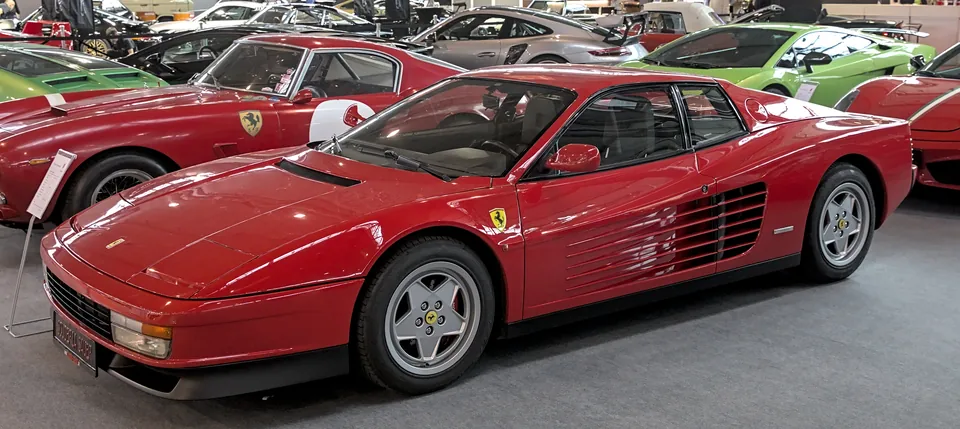
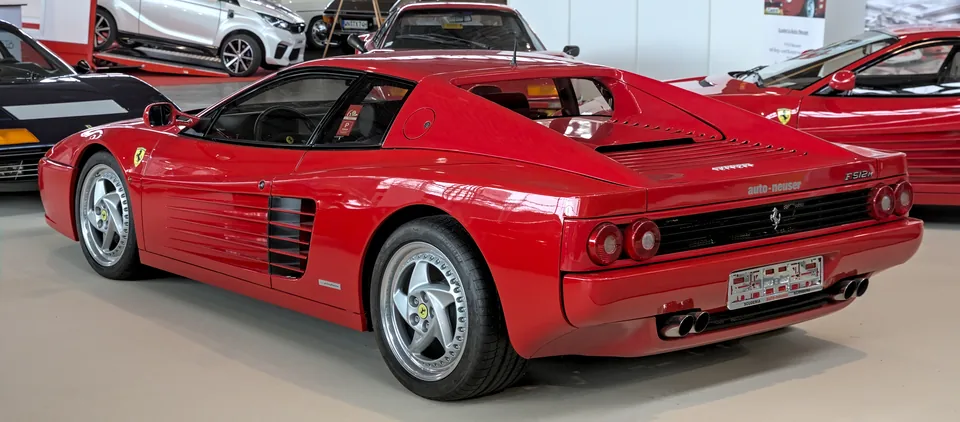
There was engineering behind the extravagance. Ferrari moved the radiators to the sides, addressing shortcomings of the preceding Berlinetta Boxer and creating substantial air intakes behind the doors. Pininfarina made those openings the defining feature of the car. The long horizontal strakes draw the eye towards the cooling ducts.
At the rear, a dark grille stretches across the lamps, visually connecting the wings beneath the broad engine deck. The closer you look, the more deliberate the extravagance becomes.

Twelve cylinders, five gears and time to enjoy them
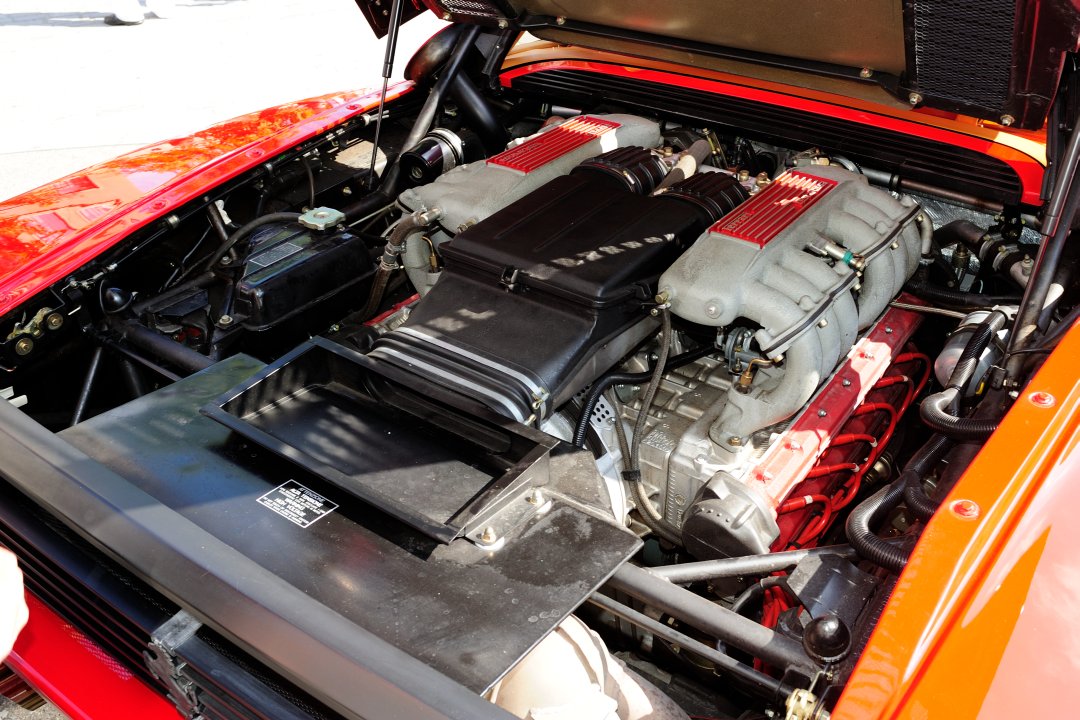
The engine is a naturally aspirated 4,943 cc flat-twelve, paired with a five-speed manual. More precisely, its architecture is a 180-degree V12. The European original delivered 390 PS and 490 Nm. Its red cylinder-head covers explain the name Testarossa.
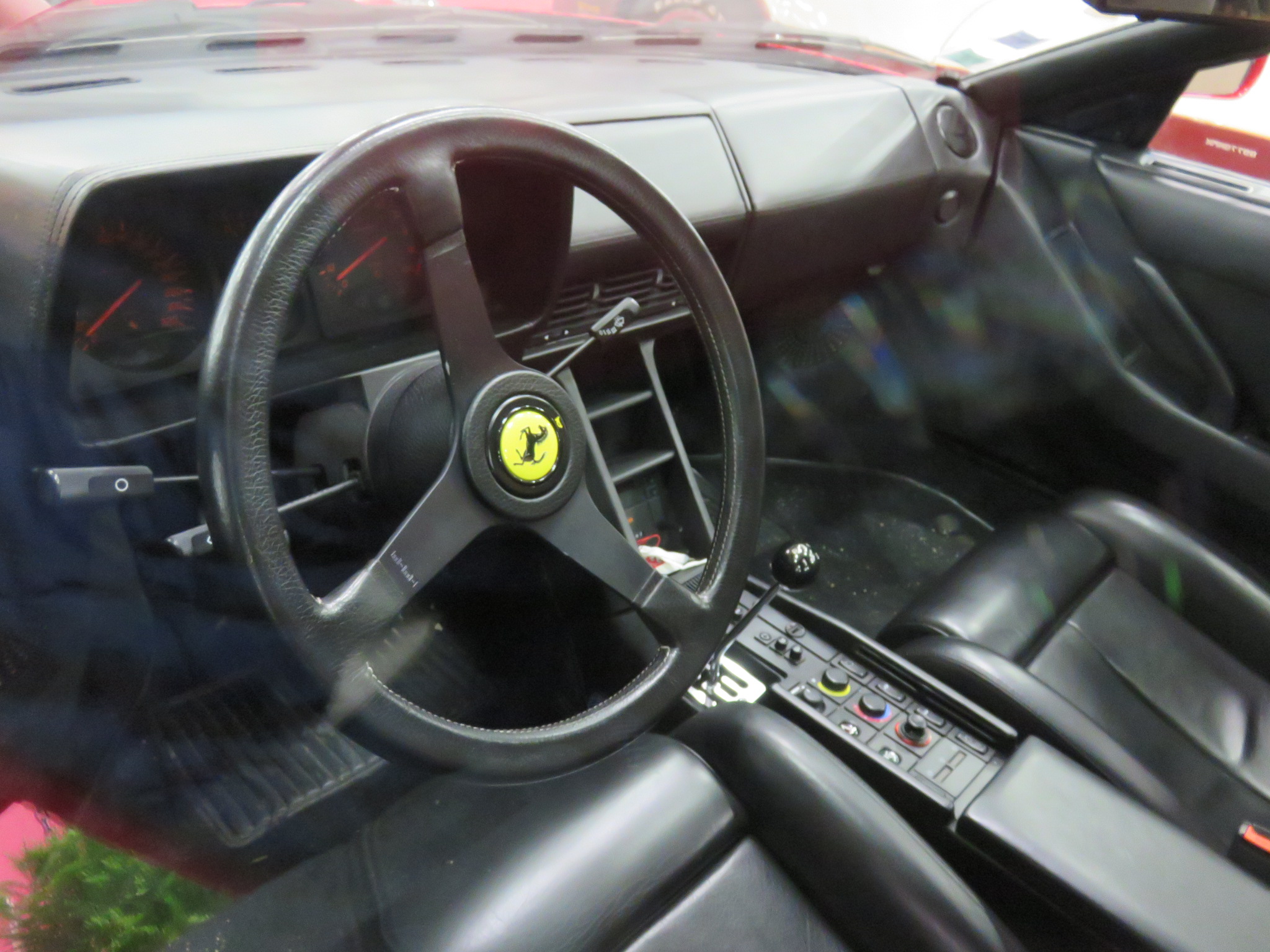
There is a clutch pedal, a metal lever and an exposed gear gate. First gear sits down and to the left in a dog-leg pattern. Each change is a deliberate action, giving an acceleration its own beginning, build-up and pause.
Listen to the yellow car as the driver opens the throttle in second at about 3,000 rpm. The note climbs until he lifts to change gear. For a moment you can hear the pause that belongs to his right hand, and then the twelve picks up again.

The original’s most appealing surprise
On an ordinary stretch of road, the 1989 car settles into its suspension. The presenter singles out the seats and the view straight back through the rear glass. Those are small things to notice in a twelve-cylinder Ferrari, until you imagine spending three or four hours at the wheel.
The cabin reinforces that character. There is a shelf behind the seats, a thin steering wheel and a dashboard full of period instruments and switches. Even the cassette storage belongs to the pleasure of encountering another era.
The reviewer is less enthusiastic about the brakes when pressing on, and the vast rear wings remain conspicuous in the mirrors. His impressions also reflect the condition of that particular car. Still, the original makes a persuasive grand tourer. Find a rhythm with the gearbox and the twelve-cylinder engine provides the occasion.

The Ferrari that belonged in a celebrity driveway
Elton John’s collection included a 1987 Testarossa that later returned to auction. Alain Delon’s 1987 example has an especially appealing Swiss connection. Artcurial documented its Swiss registration and the actor’s handwritten message in the service book. The catalogue also made one thing clear at Delon’s request. His dog Shalva would be staying with him.
Michael Jordan chose a black 1992 512 TR, famously wearing the “M AIR J” plate. CURATED’s account of its rediscovery records delivery through Lake Forest Ferrari in February 1992 and ownership until October 1995. Mike Tyson also appears among Testarossa owners in RM Sotheby’s account of the model’s cultural history.
Dr. Dre’s white Testarossa became part of his success story, an association recreated with a rented example in Straight Outta Compton. Michael Jackson’s best-documented connection is the black Straman convertible used in the 1987 Pepsi commercial The Chopper.
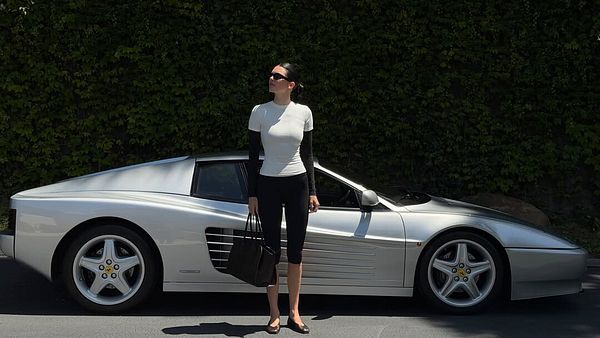
In spring 2026, Kendall Jenner appeared alongside a silver 512 TR in a fashion shoot she shared on Instagram. More than thirty years after production ended, the Ferrari caught the attention of the motoring press.
Maradona wanted his Ferrari in black
During his time at Napoli, Diego Maradona wanted a black Ferrari. His agent Guillermo Coppola later described negotiations that drew Enzo Ferrari himself into the question of colour. In Coppola’s telling, the prospect of repainting the car in Naples helped persuade Ferrari to accommodate the request.
It is easy to see why the story survived. Maradona had a precise idea of what he wanted, and even the colour of his Ferrari became an occasion. But later retellings mix details of the Testarossa and the F40. ANSA and El País point out chronological inconsistencies, and black was an available Testarossa factory colour. The tale of overturning a universal all-red rule belongs to the legend surrounding the car. The confrontation is best understood as Coppola’s much-repeated account.
With Maradona behind the wheel, the black Testarossa needed little help to attract attention in Naples.
What changed beneath the skin of the 512 TR
From a distance, the 512 TR can look like a Testarossa with new wheels and a revised bumper. Its development went deeper. Ferrari lowered the engine and gearbox, revised the chassis and reworked the engine. European power rose to 428 PS. The cabin became more coherent, while the exposed gear gate remained central to the experience.
The example in TheCarGuys’ film has lowered suspension, wheel spacers, a smaller Momo wheel, a modified shift gate and an aftermarket exhaust. Its firmer, louder character partly reflects those modifications. The original in the film also has a replacement exhaust. The comparison is most persuasive when exploring the character of these individual cars.
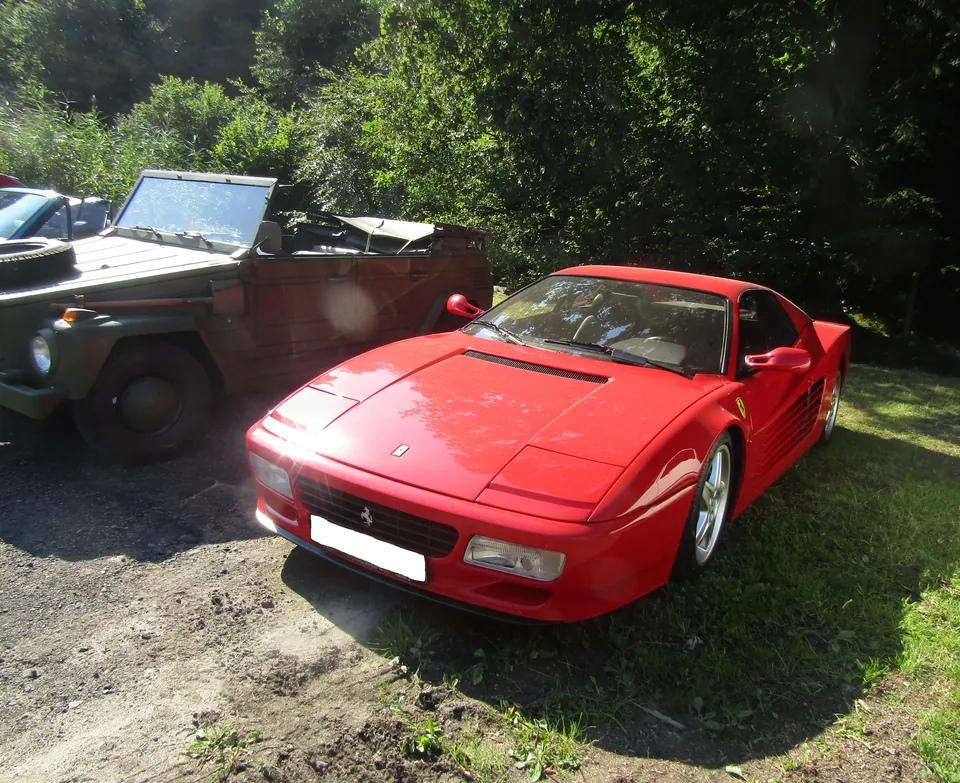

European factory specifications
| Model | Testarossa | 512 TR | F512 M |
|---|---|---|---|
| Period | 1984–1991 | 1991/92–1994 | 1994–1996 |
| Power (kW / metric hp) | 287 / 390 | 315 / 428 | 324 / 440 |
| Torque | 490 Nm | 491 Nm | 500 Nm |
| Dry weight | 1506 kg | 1473 kg | 1455 kg |
| 0–100 km/h | 5.8 s | 4.8 s | 4.7 s |
| Top speed | 290 km/h | 313.8 km/h | 315 km/h |
How to tell them apart
| Model | Testarossa | 512 TR | F512 M |
|---|---|---|---|
| Nose and headlights | Launch-era styling; pop-up headlights | Reprofiled nose; pop-up headlights | Fixed lights under clear covers |
| Rear treatment | Dark grille across rear lamps | Grille retained; revised engine cover | Separate round tail lamps |
| What changed | Side radiators and long intake strakes | Lower engine and gearbox; larger brakes | Titanium connecting rods; revised crankshaft |
The F512 M and the challenge of changing an icon
On the F512 M, the headlights stay in view even when switched off. Walk round to the back and the round lamps stand out individually where the original’s dark grille once drew your eye across the full width of the car.
Ferrari also revised the crankshaft and fitted titanium connecting rods. The European F512 M produced 440 PS and had a quoted dry weight of 1,455 kg. With it, the long run of Ferrari road cars powered by a flat-twelve came to an end.

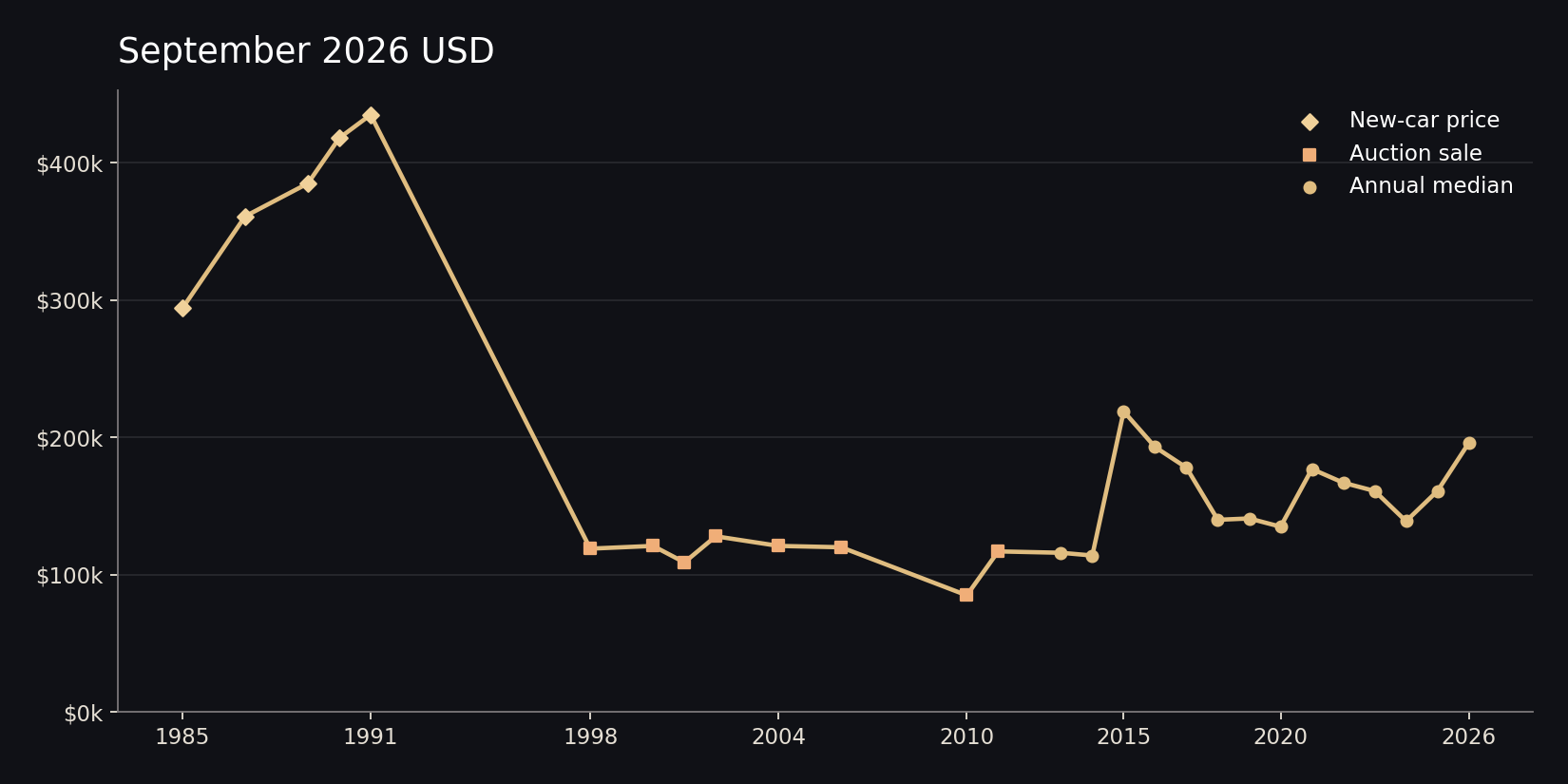
Ferrari Testarossa prices — what did the dream cost?
A contemporary Car and Driver test quoted a $94,000 base price for the 1985 Testarossa, approximately $294,000 in September 2026 purchasing power. The original purchase was a substantial indulgence even by today’s standards.
By August 2000, a red 1985 example with 68,221 miles sold at RM’s Monterey auction for $61,600. The auction notes described interior wear and suggested comparable cars could be found for about $55,000. The poster car had become a used exotic whose condition and asking price demanded careful comparison. A 1987 Monodado sold at Monterey in 2006 for $71,500.
The later sales record shows a changing collector market. Published US annual medians rose sharply in 2015, fell back by 2020 and strengthened again in 2025–2026. Inflation makes those movements more revealing. In September 2026 dollars, the 2015 median is about $219,000, compared with approximately $196,000 for the 2026 sample.
Mileage, originality, maintenance and provenance all influence the result. These samples contain different cars each year. The chart gives historical context for the dream and its changing affordability.
| Year | USD | USD · September 2026 | Source |
|---|---|---|---|
| 1985 | $94,000 | $294,000 | New-car price |
| 1987 | $121,700 | $361,000 | New-car price · Lake Forest Sportscars |
| 1989 | $141,780 | $385,000 | New-car price · Brentwood Volvo |
| 1990 | $162,250 | $418,000 | New-car price · Ogner Motorcars |
| 1991 | $175,950 | $435,000 | New-car price · Ferrari of Houston |
| 1998 | $57,800 | $119,000 | Auction sale · Kruse · Auburn |
| 2000 | $61,600 | $121,000 | Auction sale |
| 2001 | $57,240 | $109,000 | Auction sale · Kruse · Auburn |
| 2002 | $68,370 | $128,000 | Auction sale · RM · Novi |
| 2004 | $67,650 | $121,000 | Auction sale · RM · Phoenix |
| 2006 | $71,500 | $120,000 | Auction sale |
| 2010 | $55,000 | $85,000 | Auction sale · Barrett-Jackson · Newport Beach |
| 2011 | $78,100 | $117,000 | Auction sale · Barrett-Jackson · Scottsdale |
| 2013 | $80,300 | $116,000 | Annual median |
| 2014 | $79,750 | $114,000 | Annual median |
| 2015 | $154,000 | $219,000 | Annual median |
| 2016 | $137,500 | $193,000 | Annual median |
| 2017 | $129,250 | $178,000 | Annual median |
| 2018 | $104,500 | $140,000 | Annual median |
| 2019 | $106,700 | $141,000 | Annual median |
| 2020 | $104,020 | $135,000 | Annual median |
| 2021 | $142,000 | $177,000 | Annual median |
| 2022 | $144,999 | $167,000 | Annual median |
| 2023 | $146,000 | $161,000 | Annual median |
| 2024 | $129,800 | $139,000 | Annual median |
| 2025 | $155,500 | $161,000 | Annual median |
| 2026 | $196,111 | $196,000 | Annual median |
From a Testarossa dream to a Ferrari drive in Switzerland
Part of the Testarossa’s lasting appeal is the desire it creates to experience a Ferrari from behind the wheel. For readers planning a drive in Switzerland, Luxury Obsession offers the opportunity to rent a Ferrari 458 Italia. Its naturally aspirated V8, paddle-operated gearbox and later chassis bring their own character, with the engine central to the occasion.
A drive along a Swiss lake or through the Alpine landscape offers time to appreciate the response to the accelerator, the changing engine note and the anticipation of the next stretch of road.
The view that stays with you
From the Testarossa’s driver’s seat, the mirrors reveal those enormous rear wings. The shape that once filled a poster becomes part of the view on every journey.
Watch the review
TheCarGuys · Drive Every Ferrari
Loading the player connects to YouTube. YouTube