
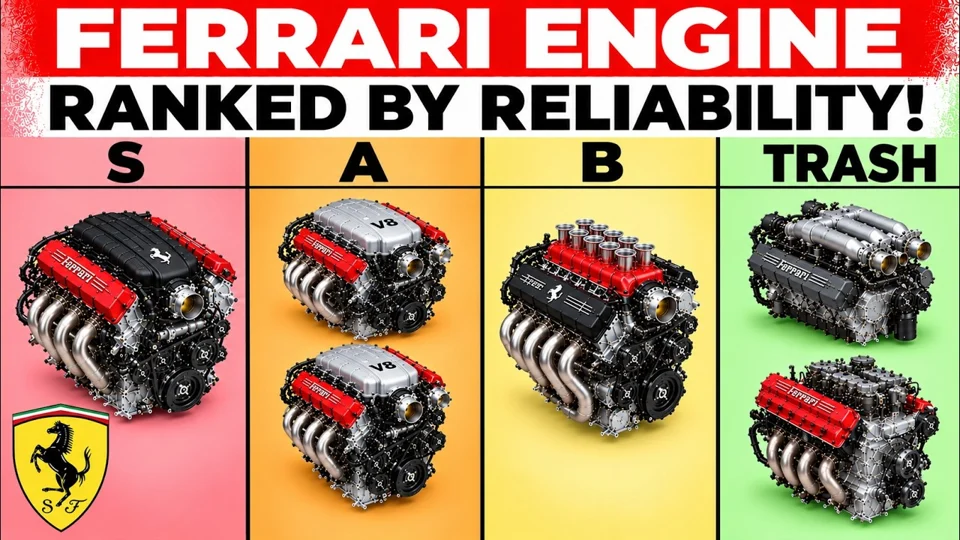
The video behind this countdown gives maintenance costs 50% of the vote, engineering 30% and legacy 20%. We follow its order and examine what each position means for someone who drives and maintains the car. Related engines sometimes share a place. The comparison concerns production road engines and reflects the presenter’s judgement rather than measured failure rates. Ranking and methodology ↗
15. 348 tb
Price the timing belt for a Ferrari 348 tb and you learn remarkably little about the service bill. The 3.4-litre V8 sits lengthways ahead of a transverse gearbox. To reach the belt, a workshop normally lowers the rear cradle carrying both. The expensive part is the time it takes to get a mechanic in front of an inexpensive piece of rubber. When looking at a 348, the date and detail on the last major-service invoice tell you far more than the price of a belt kit. With upkeep worth half the score, this is a hard place to start.
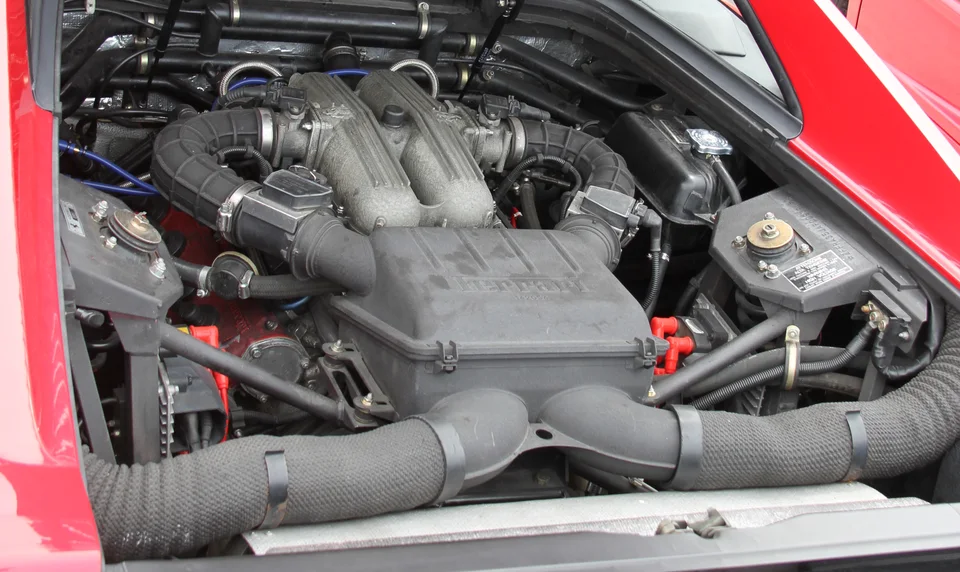
14. F355 Berlinetta
The final digit in F355 tells a story you can hear. Five valves per cylinder helped the 3.5-litre V8 breathe at the top of the rev range. The more prosaic question today is how well those valves seal. Worn guides on some early engines can let oil into the combustion chambers. A specialist also has to consider the exhaust manifolds and the history of engine-out belt services. Find a sorted example and the engineering is still a delight. Establishing that it really is sorted takes paperwork and a careful inspection.
13. Testarossa, 512 TR & F512 M
Look across the twelve intake runners of a Testarossa and the scale of the job begins to make sense. Two banks of six cylinders stretch out at 180 degrees. Opposing connecting rods share crankpins, which is why engineers distinguish this flat twelve from a true boxer. The layout gives the car much of its visual identity. It also leaves precious little working room around the engine. The video puts the Testarossa family above the 348 because scheduled access is its main objection. A large regular service bill tells you little on its own about the strength of the engine beneath it.
12. F50 V12
In the F50 the engine has a second job even with the ignition off. Its crankcase is bolted to the carbon-fibre tub and forms a load-bearing part of the car. Start the Formula One-derived 4.7-litre V12 and that same connection carries vibration straight towards the cockpit. Few road engines bring the driver this close to the competition car that inspired them. The price is a machine that needs specialist knowledge even by Ferrari standards. Twelfth place says as much about the scoring system as it does about the F50.
11. 360 Modena V8
What changed with the 360 Modena? For the technician doing the belts, the decisive feature is behind the seats. An access panel allows the job to be done with the engine in place. The 3.6-litre, five-valve V8 still needs its timing belts renewed, so the service history matters just as much as before. Yet Ferrari had removed a substantial obstacle without giving up the soaring delivery that made the F355 memorable. The next car would go a step further.
10. F430 V8
The F430 trades timing belts for chains. Owners of the 4.3-litre V8 can cross a familiar scheduled job off the list. A chain still depends on good lubrication and healthy tensioners, and the exhaust manifolds deserve attention on a used car. For the driver, the more striking change is the breadth of the engine’s response. There is useful thrust well before the final rush to the red line. Keep this engine in mind. One of the cars still to come takes its basic recipe in a different direction.
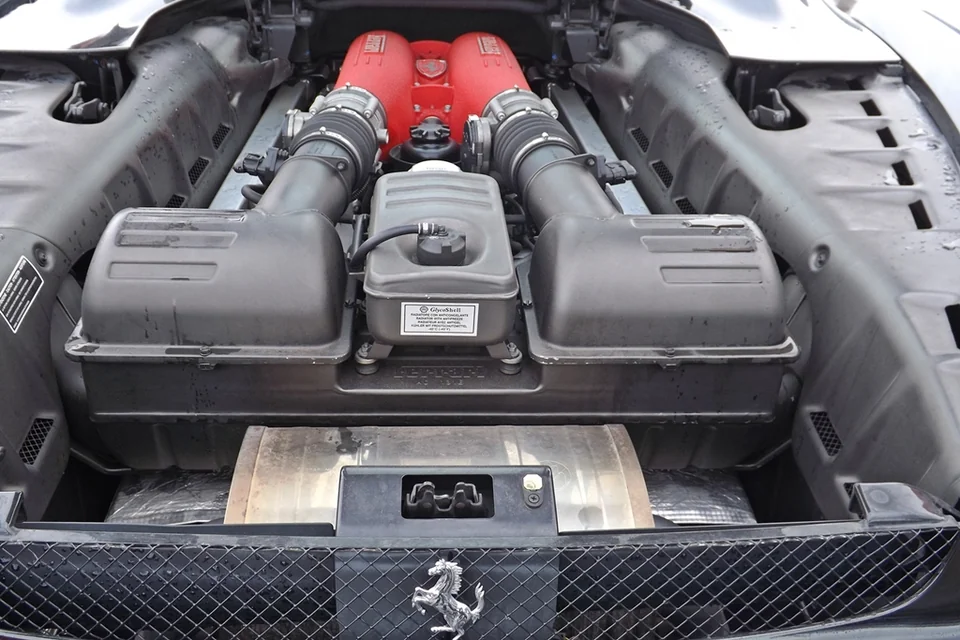
9. 488 GTB & F8 Tributo twin-turbo V8
The 488 GTB makes 670 CV and the F8 Tributo 720 CV from 3.9 litres. The real accomplishment is how Ferrari meters out that torque. A driver can feed it in progressively even though the two turbos can move far more air than a naturally aspirated engine of this size. The same hardware gives an owner more cooling lines, connections and heat to manage. The video also marks the pair down for a quieter exhaust voice. That last point is a matter of taste. The extra hardware is there whichever soundtrack you prefer.
For a closer look at how this engine feels on the road, read our Ferrari F8 Tributo review.
8. 550 Maranello & 575M V12
After the mid-engined flat twelves, the 550 Maranello put twelve cylinders back under a long front bonnet. The 575M enlarged the engine from 5.5 to 5.7 litres. Either makes a persuasive case for the grand tourer. Leave it in a tall gear, let the revs build and the car gathers speed in one long sweep. The ranking rewards that usability and the engine’s reputation when maintained. Both still use timing belts. A beautifully stamped book is more informative when the invoices show what was actually replaced.
7. Enzo & 599 GTB Fiorano V12
A six-litre V12 behind the driver in the Enzo and a related unit ahead of the cockpit in the 599. Few engine families have crossed that divide so convincingly. The Enzo introduced the F140 line. The 599 showed that its appetite for revs also suited a car built to cross a continent. Putting them together is a judgement about a family, not an assertion that the two engines are interchangeable. Their most serious rival in this countdown carries the same family name.
6. Dino 246 GT V6
At 2.4 litres the Dino’s six looks modest among these engines. Its footprint in motorsport is anything but. An iron-block V6 from the same family found its way into the Lancia Stratos, which won three consecutive World Rally Championship manufacturers’ titles from 1974 to 1976. Long before today's horsepower figures, compact dimensions could be the decisive technical advantage. The name commemorates Enzo Ferrari’s son Alfredo. For a road car originally sold under the Dino badge, sixth place among Ferrari’s greats feels particularly fitting.
5. F40 twin-turbo V8
The F40 has a way of making a tachometer feel like a countdown. Its 2.9-litre V8 builds boost and then delivers it with an urgency that modern calibration usually tries to smooth away. Launched in 1987 during Enzo Ferrari’s lifetime, it gave a generation a particular idea of what a turbocharged supercar should feel like. On the ownership side, the video cites ageing fuel cells. Specification varies by market, and the fuel system is separate from the engine itself. Even allowing for that distinction, preserving an F40 takes a specialist’s budget.
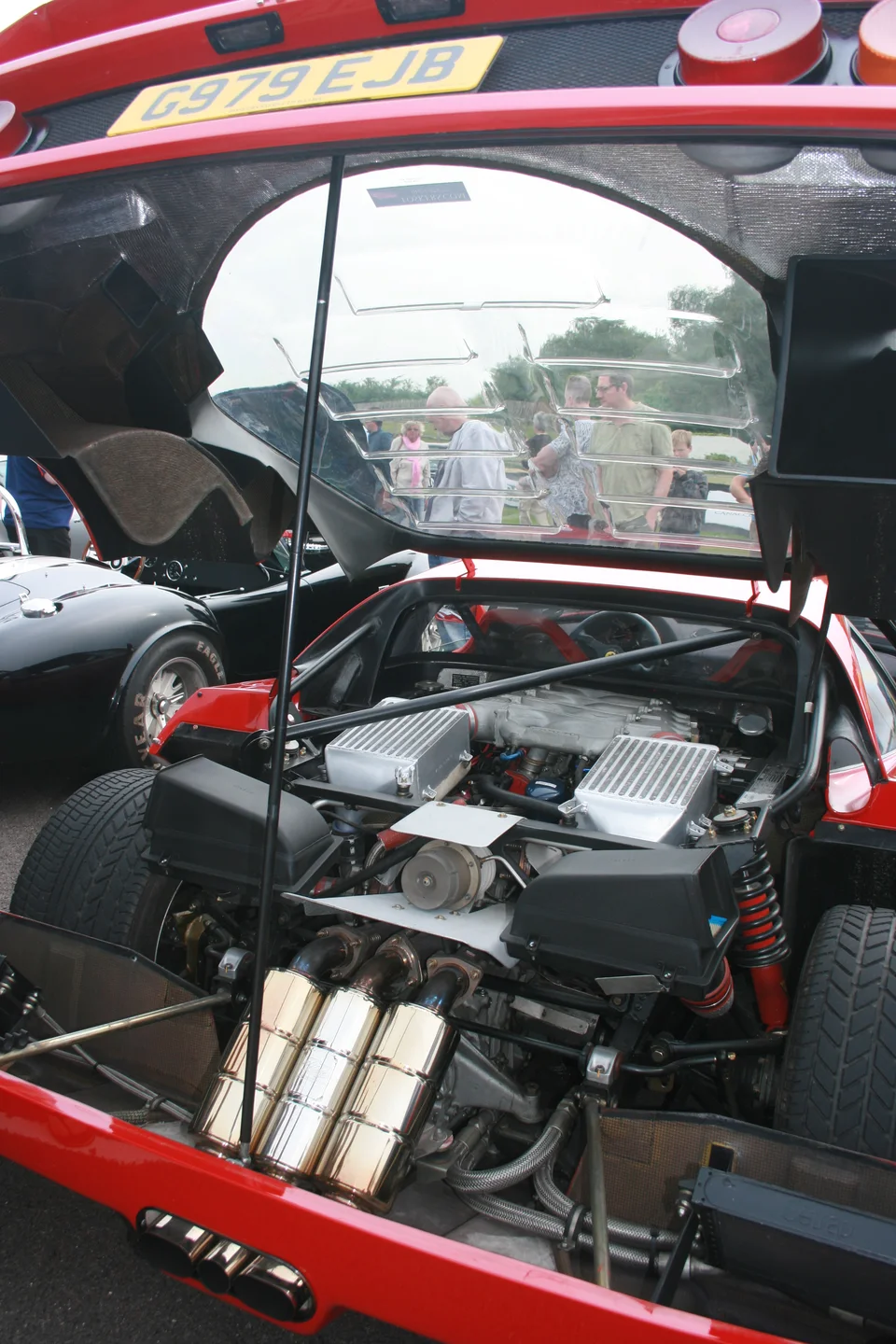
4. 308 & 328 transverse V8
How does a belt-driven Ferrari finish eleven places ahead of another belt-driven Ferrari? Turn the engine through ninety degrees. In the 308 and 328 the transverse installation lets a specialist reach the belts with the engine still in the chassis. The 328 adds a 3.2-litre V8 and, in European specification, 270 CV. That sounds modest just after the F40. Come the next major service, however, access is the specification the owner is most likely to appreciate.
3. Colombo V12
Start with twelve cylinders sharing just 1.5 litres. That was Gioachino Colombo’s answer for the 125 S in 1947. The family would go on to power Ferraris as different as the three-litre 250 GTO and the 4.4-litre 365 GTB4 Daytona. Imagine designing an engine for Ferrari’s first sports car and having its descendants still define the marque decades later. On legacy alone it is difficult to argue against first place. Here it has to share the score with the realities of owning a historic twelve-cylinder car.
2. 812 Superfast V12
The F140 returns, now displacing 6.5 litres. The 812 Superfast makes 800 CV at 8,500 rpm without forced induction. Be precise about the next number. The 9,500 rpm ceiling belongs to the later 812 Competizione, not the standard Superfast. With enough room to breathe, a big twelve can evidently do much more than deliver effortless torque. It finishes one place short in the video. Before the reveal, consider Ferrari’s Formula One V10. It has a powerful claim on sound and racing history, but it never powered a production road car. That leaves one engine.
1. 458 Italia & 458 Speciale 4.5-litre V8
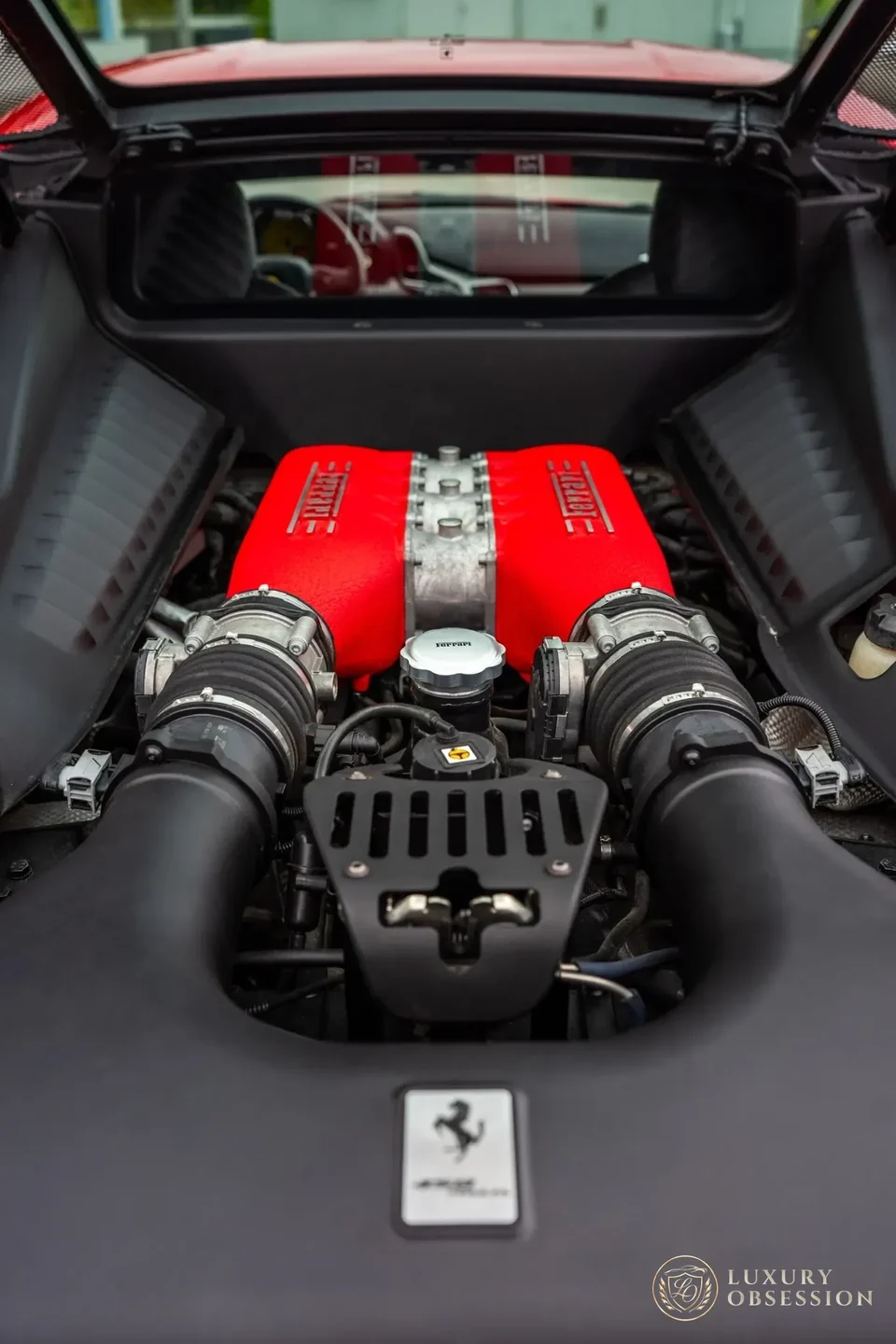
First place goes to the naturally aspirated V8 of the Ferrari 458 Italia and 458 Speciale. The Italia makes 570 CV at 9,000 rpm. The Speciale reaches 605 CV at the same speed, roughly 135 CV per litre. Both numbers use metric horsepower. Behind the steering wheel, the remarkable part is the distance between those peak figures and the first touch of the accelerator. There is no turbo waiting to spool. The engine takes a small throttle input immediately and still has thousands of revs in reserve.
The flat-plane crank was already part of the F430 formula. What the 458 adds is direct injection, more displacement and a higher operating ceiling, while retaining chain-driven camshafts. It avoids a scheduled timing-belt change without adding two turbos and their plumbing. The early 458 fire recall mentioned in the video concerned the wheel-arch heat-shield attachment. It matters when checking a particular car’s history, but it tells us little about the V8’s internals.
Its place in Ferrari history completes the case. After the Speciale, the 488 GTB took the mid-engined V8 line into the turbo era. Change the weights and the Colombo could win on history or the F50 on engineering. Keep them as the video sets them, and the 458 wins for bringing so many of those qualities within reach of a road driver.
Explore the specifications and variants in our Ferrari 458 Italia guide.
Watch the original countdown


Loading the player connects to YouTube. Watch on YouTube.