
Switzerland is one of the cleaner European markets to study modern Ferraris. Cars are often well documented, specifications tend to be visible, and buyers usually pay attention to condition rather than chasing the absolute cheapest listing. That makes Swiss asking prices a useful signal for anyone tracking the Ferrari 458 Italia, 458 Spider, 488 GTB, or 488 Spider.
This is not a claim about exact transaction prices. It is a practical reading of Swiss asking prices. The goal is to understand which models stay firm, how mileage shapes the market, and why some configurations remain easier to defend on value.
Swiss Ferrari prices make more sense when you filter the noise
On a classifieds site, the cheapest ad is often the least useful one. Extremely high mileage, weak history, or unusual configurations can distort the picture. For that reason, the most helpful comparison is not every listing on the page. It is the middle of the market, especially cars with sensible mileage, believable history, and specification choices that buyers actually want.
That is why the charts in this article focus on a cleaner subset of the Swiss market. It is a better way to compare a Ferrari 458 against a Ferrari 488 than looking at one dramatic outlier.
Broadly, the analysis focuses on cars that still feel fresh for the segment, roughly up to about 60,000 km, without obvious compromise stories.
Condition, history, and spec still matter more than a headline bargain. That is exactly why asking prices remain informative in a market like Switzerland.
Price trend by registration year
The first chart shows median asking prices by first registration year. It does not tell you what every individual car is worth. What it does show is the shape of the Swiss market once the noisiest listings are filtered out.
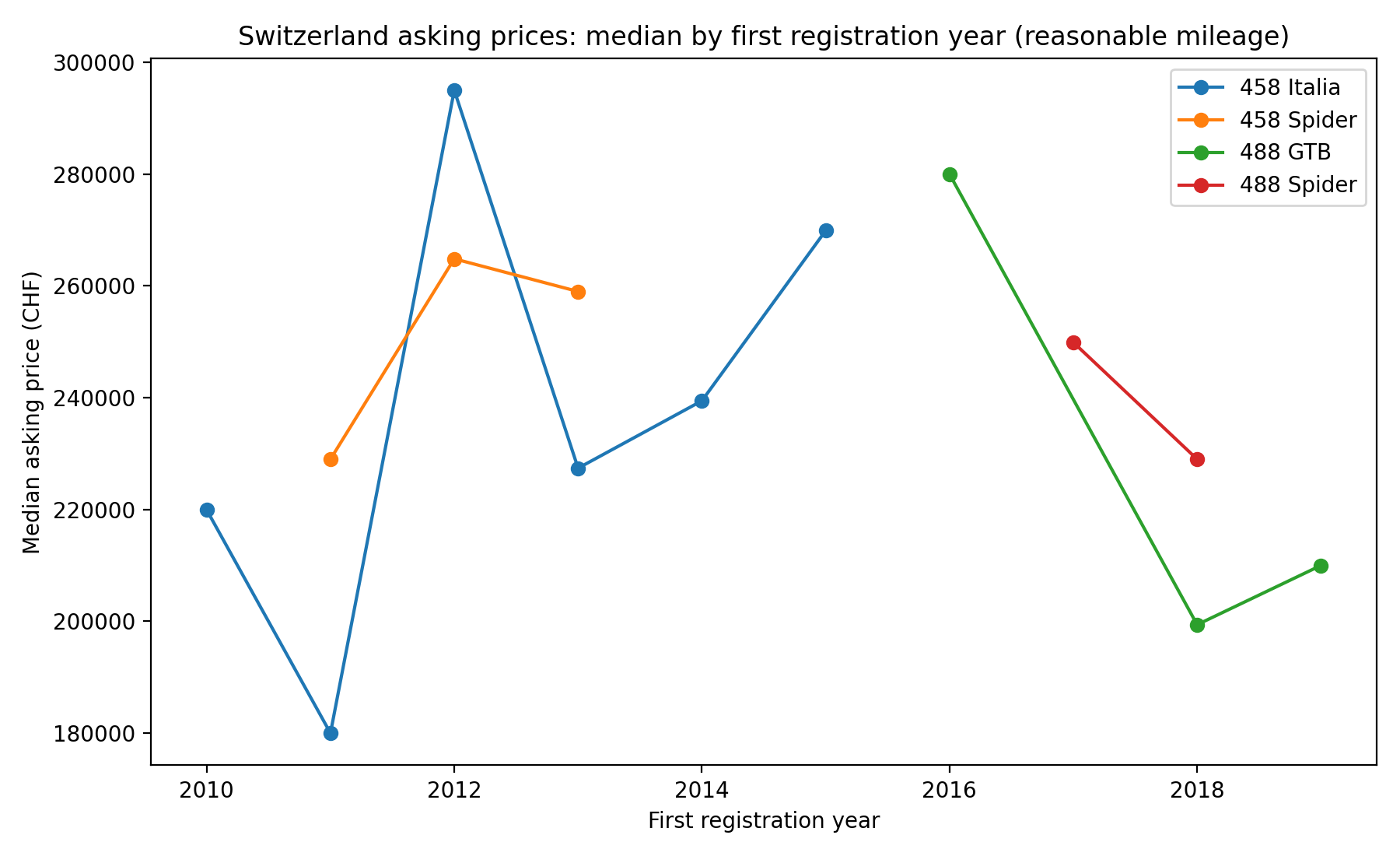
The broad message is clear. Clean Ferrari 458 examples continue to trade in a firm band relative to their age. The Ferrari 488 range can still be strong, but it generally behaves more like a newer performance car market and less like a car buyers are already starting to treat as a modern classic.
Mileage still moves the market
The second chart shows how much mileage still matters in Switzerland. That should not surprise anyone, but the shape is useful. Buyers may forgive age more easily than they forgive kilometres that feel excessive for the model and the price bracket.
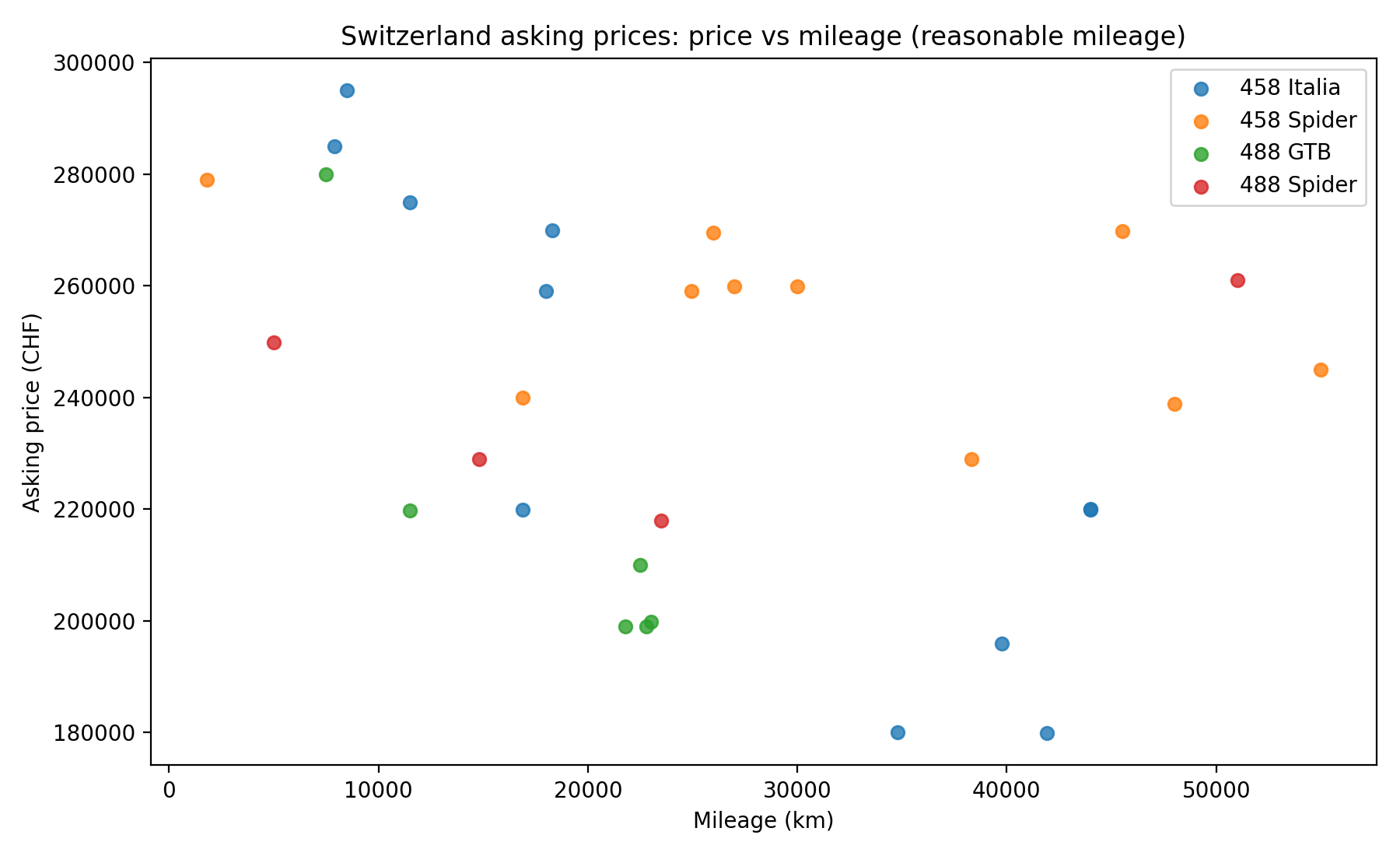
For buyers, this matters because a Ferrari with reasonable mileage is not only easier to enjoy. It is usually easier to explain again when the time comes to sell. For sellers, it means that crossing certain mileage thresholds can reduce pricing power faster than expected.
Ferrari 458 vs Ferrari 488 in Switzerland
The Ferrari 458 family looks unusually resilient. The naturally aspirated engine, the sense that it marks the end of an era, and the emotional pull of the design all support the market. The Ferrari 488 is objectively brilliant, faster in many ways, and often the more rational performance choice. But rational cars do not always behave like emotional assets.
Ferrari 458 Italia and 458 Spider
Modern classic signalThe 458 range carries naturally aspirated appeal, stronger theatre, and a clearer sense of occasion. In Switzerland, that tends to support firmer asking prices for clean cars.
Ferrari 488 GTB and 488 Spider
More price responsiveThe 488 range delivers immense pace and broader usability, but prices usually react more quickly to supply, mileage, and seller urgency.
Listing history is imperfect, but still useful
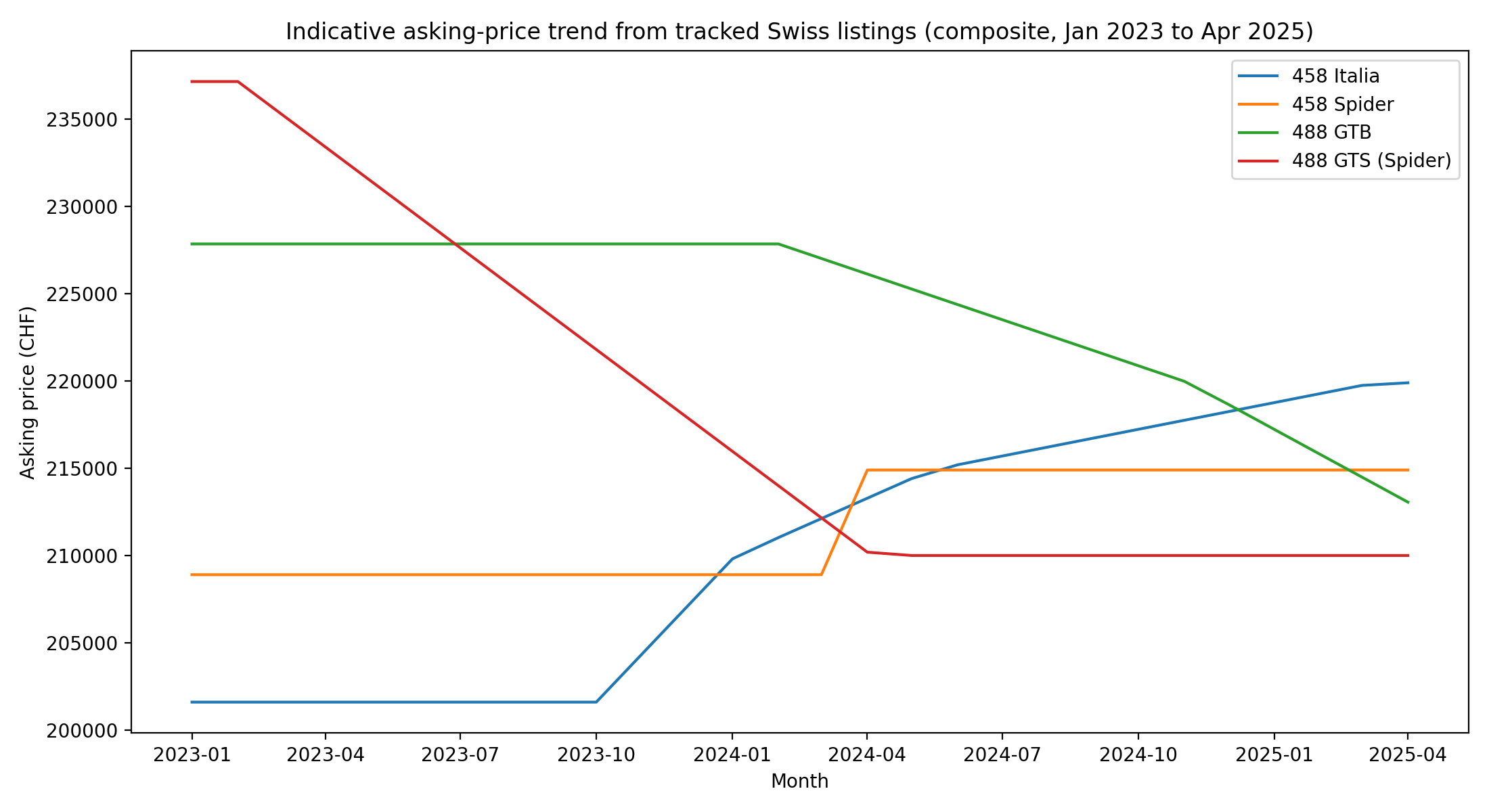
When Swiss platforms show price history on individual ads, they do not reveal the whole market. Still, they do show whether sellers are holding firm or gradually walking prices down. Aligned across the same time window, those listing histories help illustrate market behaviour in a way a single price point cannot.
Does factory red still matter
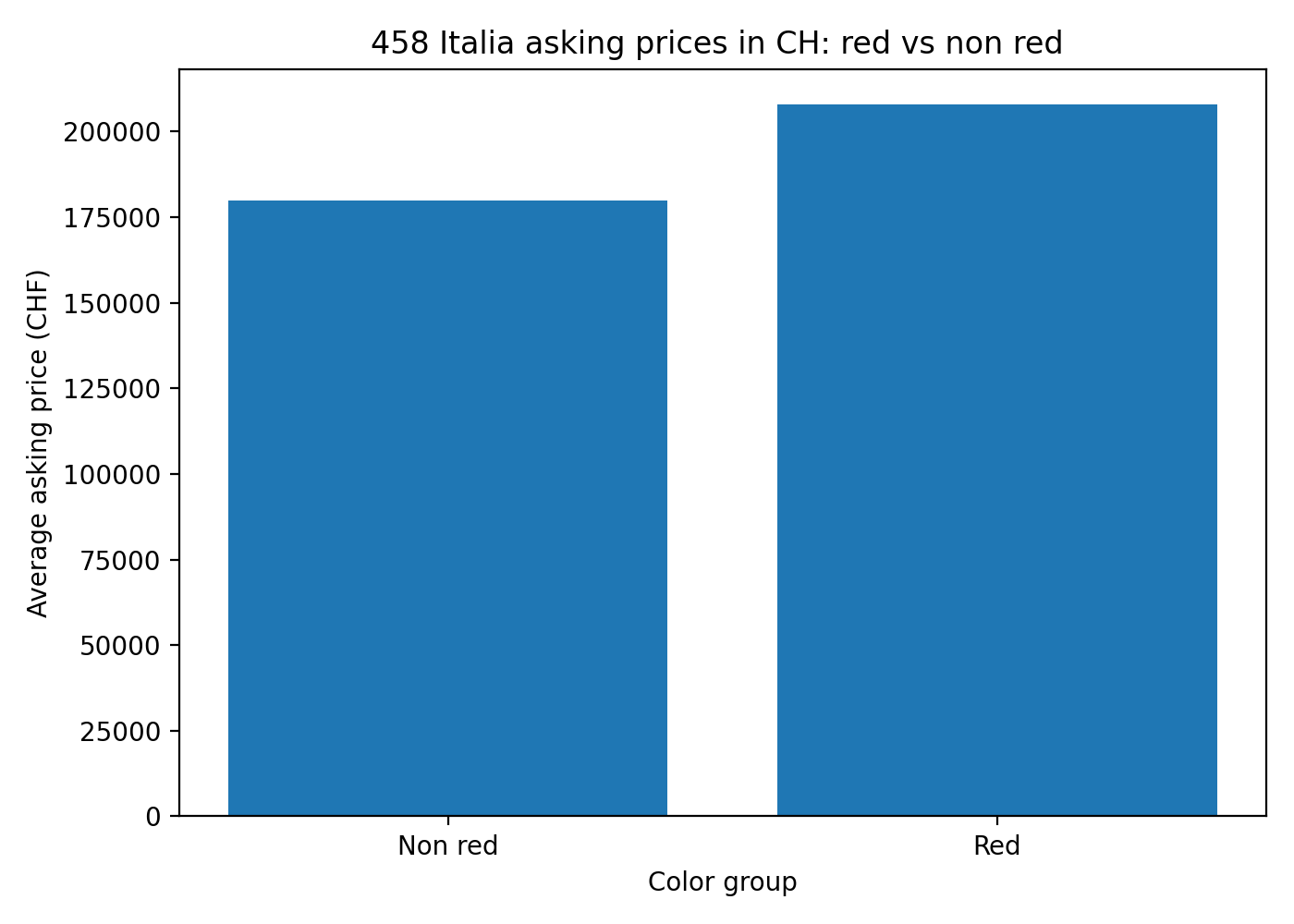
Colour is never the whole story, but it is one of the easiest ways to understand buyer psychology. On Ferraris, factory red still carries symbolic weight. In a close comparison between two similar cars, colour often becomes the tie breaker. In the Swiss sample behind this article, red examples tended to sit above comparable non red cars when the rest of the package looked similar.
How to read these charts if you are shopping in Switzerland
If you are looking for a Ferrari 458 or Ferrari 488 in Switzerland, the most useful approach is to read the charts alongside real world detail. Mileage must make sense for the age. Service history must be clean. The specification should feel coherent. A car with visible enthusiast options, believable ownership, and the right colour story is easier to defend both emotionally and financially.
That is also why strong 458s remain interesting. They combine special engine character with a market profile that looks more stable than many buyers expect.
We run a factory red Ferrari 458 Italia in Zurich with the options enthusiasts actually notice, including the carbon fibre steering wheel with LED shift lights. The same details that make a car memorable to drive are often the ones that help it remain desirable.
Bottom line
If the question is value behaviour rather than absolute speed, the Swiss charts support a simple conclusion. The Ferrari 458 family behaves more like a modern classic. The Ferrari 488 family remains a serious performance proposition, but it reacts more quickly to mileage, supply, and pricing pressure. In Switzerland, that difference is visible even before private transaction data enters the conversation.
Frequently asked questions
Are these transaction prices or asking prices
These are asking prices from Swiss listings. They are not final sale prices, but they still give a useful market signal when the sample is filtered carefully.
Why focus on sensible mileage
Because extreme mileage or unusual histories can distort the comparison. Buyers in Switzerland usually price condition, history, and mileage together.
Does the Ferrari 458 really hold value better than the Ferrari 488
The charts suggest that clean 458 cars are firmer relative to age, while 488 asking prices tend to respond faster to supply and seller pressure.
Why mention factory red
Because colour remains an important part of Ferrari buyer psychology. It is not everything, but it often helps explain why two otherwise similar cars sit at different price levels.